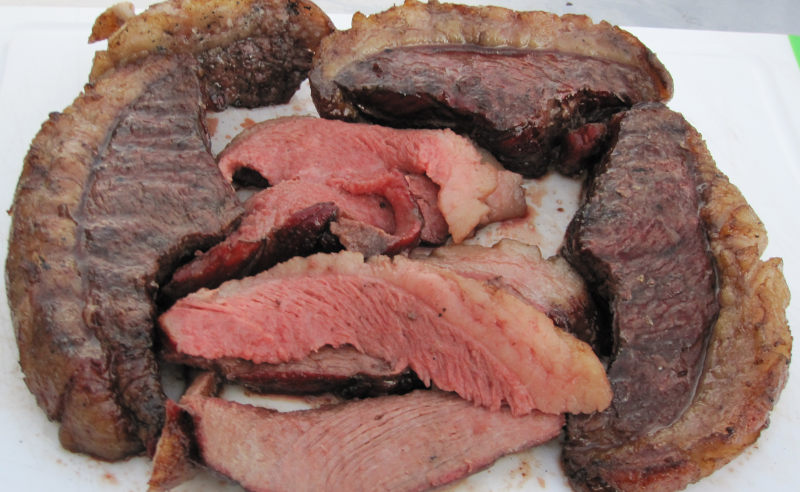
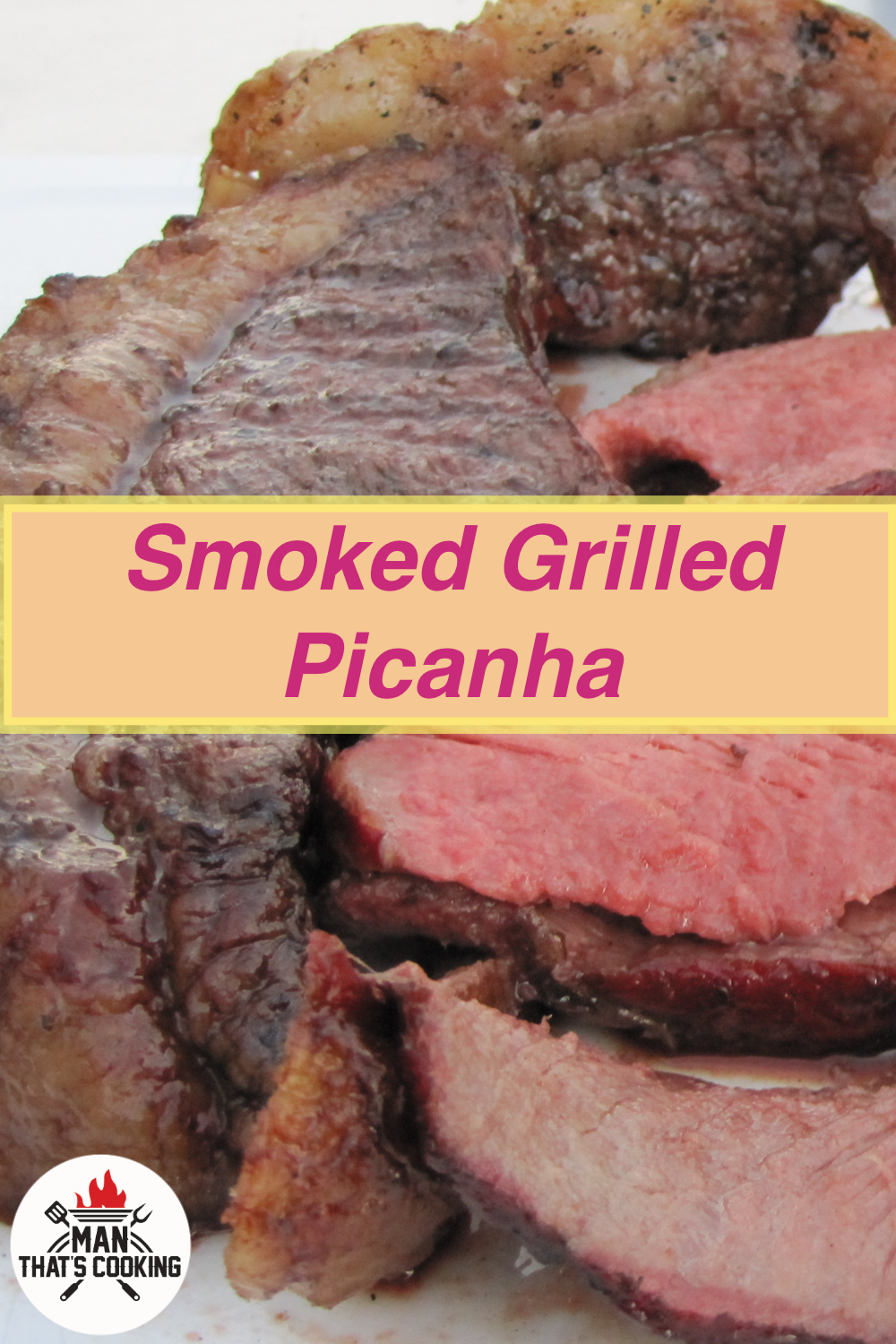
Have you tried grilled picanha aka sirloin cap? This is a cut of beef that is traditionally cooked in Brazil and is one of the top meats there. In the United States, it is sold as sirloin cap and sometimes you will see it labeled as picanha. This recipe takes the cooking method to another level by smoking the meat prior to grilling. Sticking to tradition, the only seasoning used in this recipe is BBQ salt during grilling time. This results in a flavor of delicious beef with earthy smoke fire and salt.
Directions
First score the fat cap with a knife but do not touch the meat underneath. Create a grid which allows the fat to escape and flavor the meat.
Next using the knife, on the meat side, mark the grain of the meat by making a slice in the grain direction. This will be useful when slicing so that slices will be against the grain for more tenderness.
Next place the meat on the smoker fat cap up (debate this in the comment section) with the smoker at 165 F using mesquite wood. Just to clarify, there was no seasoning or marinade used with the meat at this point.
Smoke the meat for 2 hours then pull it and slice it with the grain into 2 finger width chunks. Salt liberally one side of the meat with kosher salt or Brazilian BBQ salt.
Place the meat on a medium temperature grill salt side down (again, debate this in the comment section) for 5 minutes, then flip to the unsalted side. Finally flip to the fat cap side and allow it to burn in the flame. Stay near the grill at all times and do not close the lid during this cook phase.
When the meat reaches 130F pull it from the grill and allow it to rest for 5 minutes before slicing against the grain and enjoying.
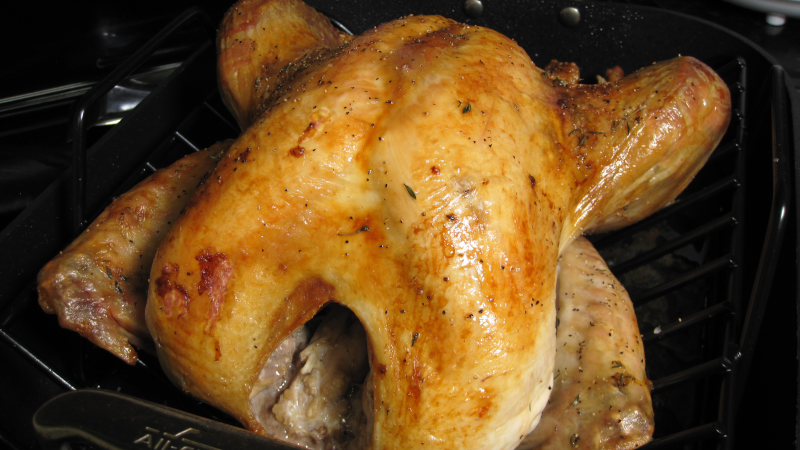
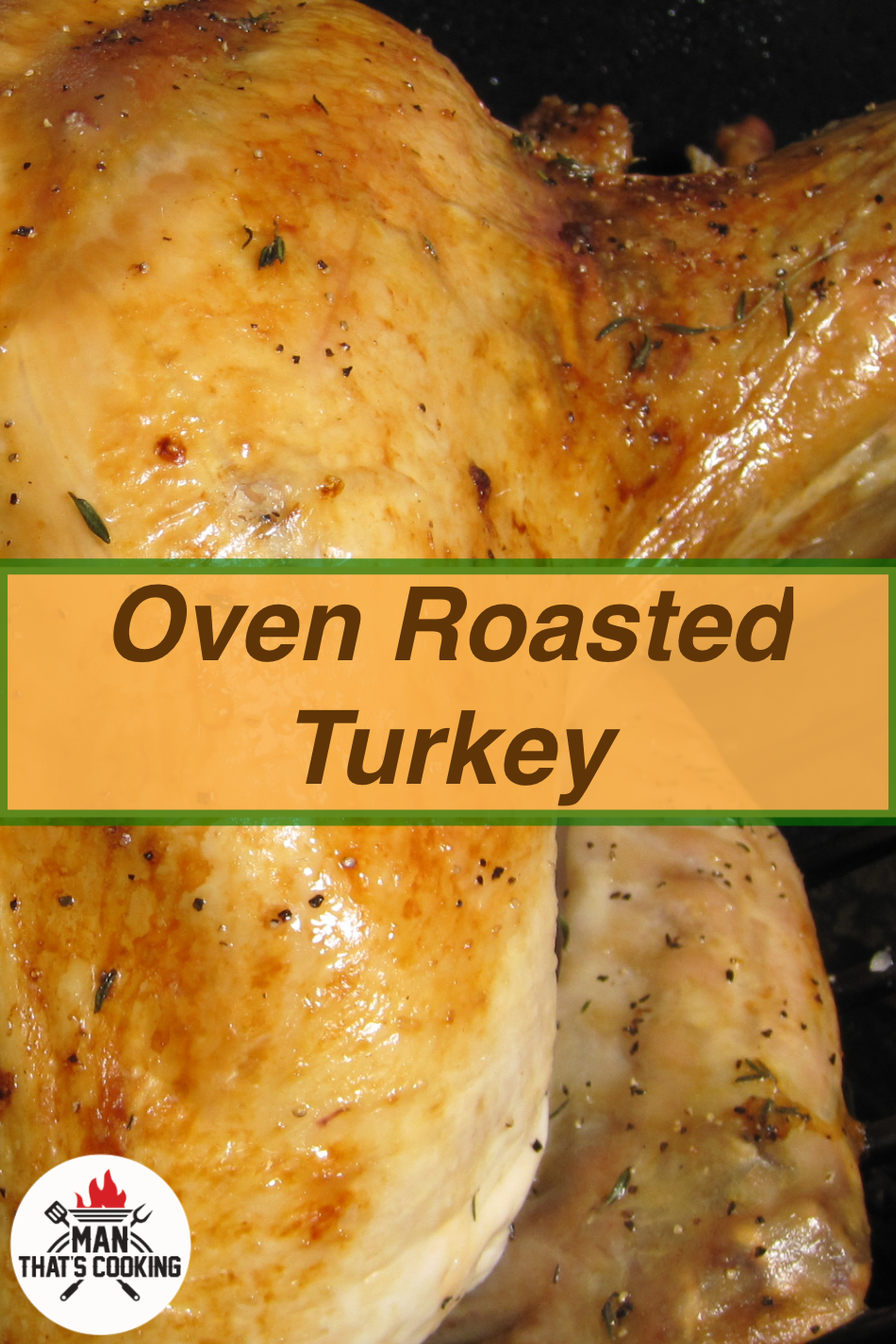
Any time is a great time for turkey and when it comes to the holidays, it’s a big deal. This is nothing to worry about and if you follow this recipe, your turkey will impress all of your guests. This recipe uses a brine which is an optional step but highly recommended. Most store bought turkey is frozen in a solution to make the meat juicy. Because of this pre processing, a brine is not necessary however it will enhance the overall outcome. And if you sourced your turkey from something other than the grocery store (hunting, backyard farm or otherwise) then a brine is an excellent enhancement. If your turkey is frozen, you will need at least 48 hours of thaw time with the turkey in the refrigerator. The brine is easy to prepare and you can do this any number of days ahead and keep it in the refrigerator. The turkey should be brined for 4 to 6 hours max and then washed off and dried with paper towels. Then you should let the turkey dry out in the refrigerator for 24 hours. This will help the skin to become crispy and delicious.
So let’s step through this, assuming this will be a Thanksgiving Thursday turkey and you work 9 – 5 like all of us. Sunday at noon place the turkey in the refrigerator to thaw out. On Monday evening, make the brine and place it in the refrigerator. By Tuesday evening the brine will be cool and the turkey will be thawed and ready to brine for 4 – 6 hours. Tuesday night remove the turkey from the brine, wash off the brine, then dry it with paper towels. Place the turkey on a cooling rack over a foil layer on a cookie sheet. Place the turkey in the refrigerator from Tuesday night to Thursday morning (a little over 24 hours, no biggie). Thursday morning / afternoon season the turkey and roast in the oven. This recipe will cook at 325 F and turkey will require 15 – 17 minutes per pound when cooked at 325 F. So a 12 pound turkey at 16 minutes per pound = 192 minutes total time (12 x 16) which is 3.2 hours (192 minutes / 60 minutes per hour).
Directions
If your turkey is frozen, allow it to thaw for 48 hours prior to brine or cooking. For this recipe if you target Thanksgiving Thursday, start the turkey thawing on Sunday.
Prepare the brine several days ahead of the cook. For Thanksgiving, this would be Monday evening. Allow the brine solution to cool down, then place it in the refrigerator to cool it further overnight. The next evening (Tuesday) soak the turkey in the brine for 4 to 6 hours. You can use 1 gallon XL zip seal bags to brine the turkey if you don’t have any containers large enough for the task.
After this, wash the turkey and place it on a cookie sheet and cooling rack setup. Dry it inside and out with paper towels and place in the refrigerator.
On Thursday, remove the turkey from the refrigerator and brush it down on all sides with melted butter. If you use salted butter, then apply less salt on the surface in the next step. Salt and pepper the turkey on all sides.
Move the turkey to a roasting rack breast side up. Tuck the wing tips under the body of the turkey. Add fresh thyme to the turkey skin. Do not truss the turkey legs unless your grandma makes you do so. This is an old technique that is debated endlessly at this point.
Preheat the oven to 325 F and cook for 1 and a half hours.
Open the oven, slide out the turkey or remove it and brush it down with melted butter. Take the temperature of the turkey and do the math for the remaining cook time. Turkey will require 15 – 17 minutes per pound when cooked at 325 F. The target temp is 165 F in the breast and 175 F in the thigh.
When the turkey breast reaches 165 F in the thickest part of the breast, it is safe to remove it from the oven. Allow the turkey to rest for 30 minutes and do not cover it with foil. If you cover it with foil, condensation will form and will drip back on the skin making it less crispy. Print This Recipe
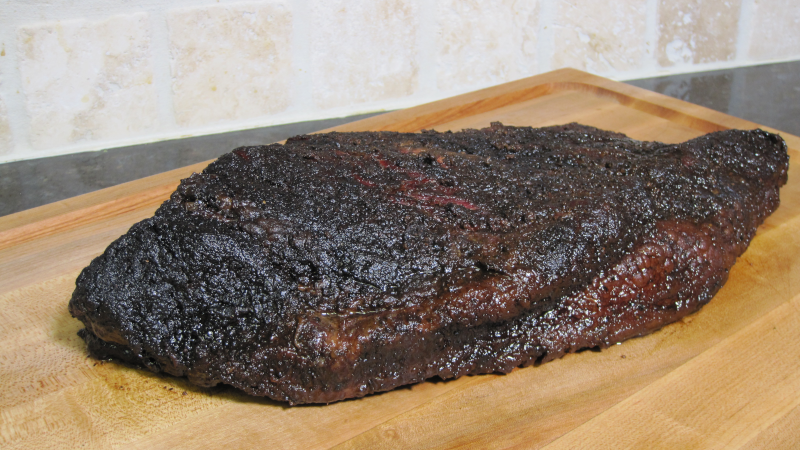
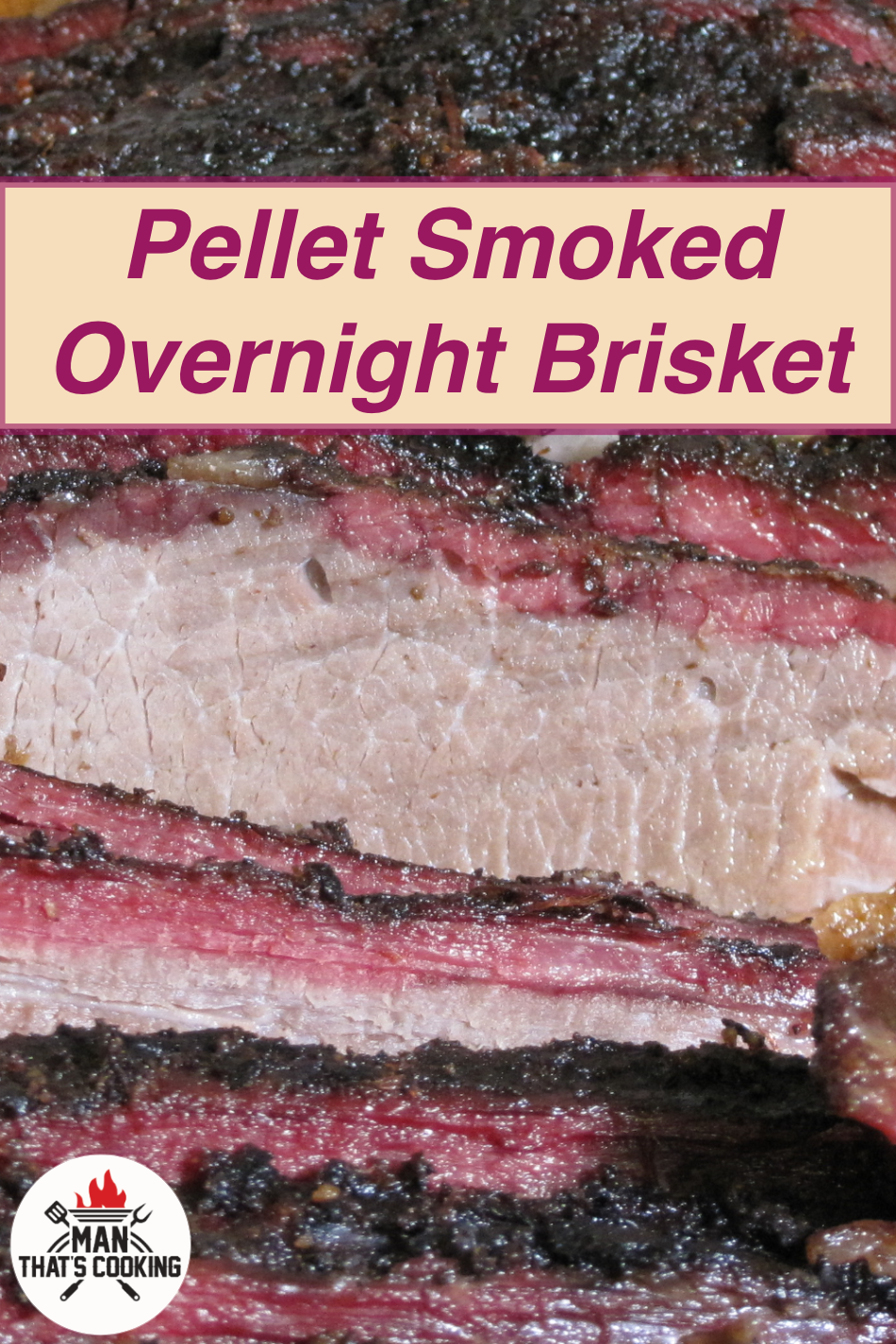
Cooking a brisket overnight on a pellet smoker is one of the most epic cooks that you can achieve on this cooking machine. There is no fire to tend to like an offset smoker would have you do, so you just fill the pellet hopper to the max and sleep till morning. But let’s be real, the sleep won’t be so good especially if you spent some big coin on a prime brisket. You can reduce your sleep anxiety by using a wireless thermometer and setting a 202 F max temp alarm for the brisket and a 180 F low temp alarm with an ambient probe for the smoker. If you are a heavy sleeper you probably should set the brisket max temp alarm at 155 F to wake you when the brisket nears the stall stage. Keep in mind this stall temp could range from 145 – 175 F so you will need to observe the temp around this time. This temp should hit sometime in the early morning so be ready to get out of bed and tend to your cook. Wrapping a brisket will allow it to get past the stall stage and it will make the meat tender by braising it in its juices. You can wrap the brisket with aluminum foil or butcher paper. If you choose aluminum foil, the seasoning bark may wash off somewhat from trapped steam. On the other hand, butcher paper will allow some moisture to escape giving you a thick bark. When the brisket reaches between 202 – 205 F in both the point and flat, take additional readings with a handheld thermometer to confirm this temp. You can also tell when the brisket is ready by feel. When the temp probe slides into the meat like butter with little resistance, then it’s done. When this happens you need to place the brisket in a cooler and let it rest for at least 1 to 2 hours. After this rest period it is ready to unwrap, slice against the grain and enjoy.
Man That’s Cooking
Ingredients
12 – 15 pound full packer brisket (choice or prime)
Directions
First, using a flexible boning knife trim the discolored edges off the brisket on all 4 edges.
Next trim all hard fat from the brisket on all surfaces. Keep the fat cap side in place but reduce any hard buildup fatty areas. You want to avoid scalping the fat into the meat but leave 1/4 inch of a fat layer.
Next rub down one side with a coating of worcestershire sauce and then apply your favorite BBQ rub. Flip the brisket to the other side and repeat. Wrap the brisket in cellophane wrap and refrigerate several hours, ideally 5 hours.
Around 11 pm, remove the brisket from the refrigerator and allow it to warm on the countertop for 15 minutes. Start the smoker at 230 F using hickory pellets and a fully loaded hopper. Ideally this will be a 20 pound bag of pellets. Place the brisket on the top rack if you have one, with the fat cap down and the point facing the hot spot such as the exhaust. Place a temp probe in the point and set the alarm for 155 F and set an ambient probe temp for 180 F low alarm.
When the alarm alerts, monitor the temperature for a few minutes to see if it stays nearly the same. When this happens, wrap the brisket in two overlapping strips of butcher paper. Place the brisket back on the smoker and re-insert the temperature probe(s). Increase the smoker temperature to 250 F. Increase the brisket alarm max temp to 202 F. Check the pellet level in the hopper and add any if needed.
Continue to cook until the temperature probes signal the alarms. At this point, move the probes around to get additional readings and take an average of those readings. Some areas will be higher in temp than others, and you want to go with the mid to lower temp areas as your current temp. When the brisket reaches temp the meat will be very tender and the temp probes will slide in like butter. If that is not happening, you need to continue the cook and re position the temp probe.
When the brisket reaches temperature and the meat is tender, place it in a small cooler and let it rest 1 to 2 hours. If you have a large cooler, wrap the brisket in a towel to keep it insulated.
After the resting period, slice the brisket against the grain, usually starting diagonally from the lower flat corner. Turn the point and slice it against the grain.
It’s getting cold outside and that means it’s chili time! Turkey chili can be a rewarding meal when you are hungry and need to warm up. This recipe is easy to make except for all the veggie chopping, but that is normal. If you never had ground turkey instead of beef in your chili it’s not bad like you may be thinking. The texture can be slightly different and the flavor is not the same but let’s address that. This recipe calls for 1 can of beef broth and a beef bouillon cube. This adds the beefy flavor that you are used to and makes it quite similar in taste. But hey if you are really into poultry, then you can use chicken broth and bouillon instead. Now let’s talk smoke cause that is where the flavor is at. For this recipe we use apple wood pellets to keep things mild and not too overpowering. You can add some pecan to increase the smoke flavor if that’s what you are into. As with any chili you can go off script and add your favorite ingredients and wood pellets.
Directions
First, dice the onion, poblano pepper, tomatoes and one jalapeno pepper. Slice the second jalapeno pepper and set aside. Mince or finely dice the garlic cloves.
In a large skillet, saute the onions in a small amount of butter. Add diced poblano and one diced jalapeno. When the onions begin to turn translucent, add the garlic. Add a splash of beef broth. Cook for 1 minute then add the turkey meat. Mix the turkey meat around, breaking up any clumps into smaller pieces. Add the taco seasoning and continue to cook until the meat is browned and no longer pink.
Add the canned items into a large cast iron skillet or foil casserole pan. Next add the diced tomatoes and the turkey and onion mixture. Add the seasonings then stir everything together.
Place the skillet or pan on the smoker running at 275F with apple wood pellets. Cook for about 4 hours and stir the chili every 30 minutes. Near the end of the cook, if the chili has excess liquid, use an immersion blender to thicken it up.